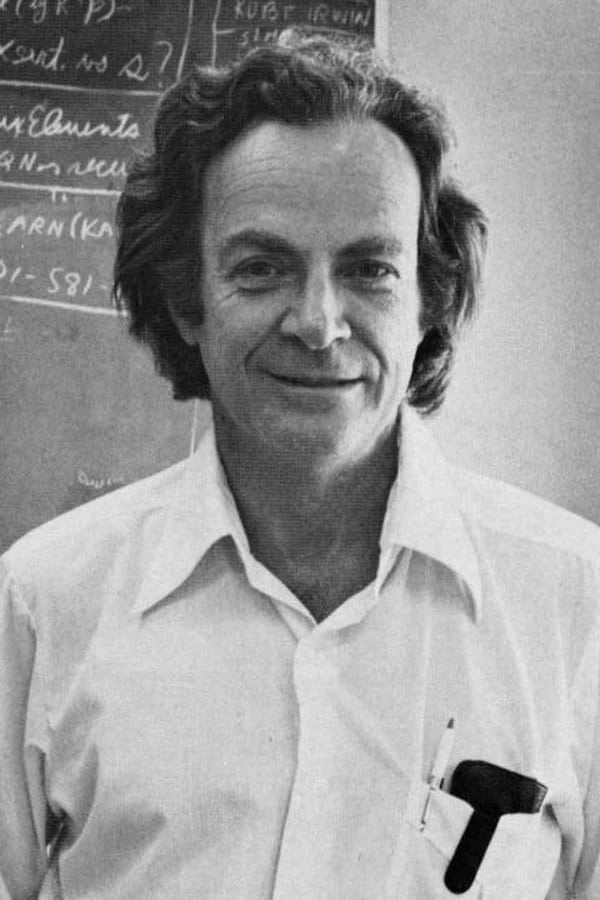
Richard Feynman
Professor of Physics, California Institute of Technology
Theoretical physics is a branch of physics that focuses on the development of mathematical models and theories to understand and explain natural phenomena. It plays a crucial role in our understanding of the fundamental laws of the universe and the fundamental particles that make up all matter. Research in theoretical physics helps us to make predictions about how the universe works and to test these predictions through experiments.
Awarded the Nobel Prize jointly with Julian Schwinger and Shin'ichiro Tomonaga for fundamental work in quantum electrodynamics, with deep-ploughing consequences for the physics of elementary particles.
Selected publications
-
1982Feynman, R. P. (1982). Simulating physics with computers. International Journal of Theoretical Physics, 21(6–7), 467–488.
@article{feynman1982simulating,
  title = {Simulating physics with computers},
  author = {Feynman, R. P.},
  journal = {International Journal of Theoretical Physics},
  volume = {21},
  number = {6--7},
  pages = {467--488},
  year = {1982},
  doi = {10.1007/BF02650179}
}
A digital computer is generally believed to be an efficient universal computing device; that is, it is believed to be able to simulate any physical computing device with an increase in computation time by at most a polynomial factor. This may not be true when quantum mechanics is taken into consideration.
-
1969Feynman, R. P. (1969). Very high-energy collisions of hadrons. Physical Review Letters, 23(24), 1415–1417.
@article{feynman1969partons,
  title = {Very high-energy collisions of hadrons},
  author = {Feynman, R. P.},
  journal = {Physical Review Letters},
  volume = {23},
  number = {24},
  pages = {1415--1417},
  year = {1969},
  doi = {10.1103/PhysRevLett.23.1415}
}
A model for the description of high-energy collisions of hadrons is proposed. In this model hadrons are composed of point-like constituents, called partons.
-
1949Feynman, R. P. (1949). Space-time approach to quantum electrodynamics. Physical Review, 76(6), 769–789.
@article{feynman1949spacetime,
  title = {Space-time approach to quantum electrodynamics},
  author = {Feynman, R. P.},
  journal = {Physical Review},
  volume = {76},
  number = {6},
  pages = {769--789},
  year = {1949},
  doi = {10.1103/PhysRev.76.769}
}
In this paper two things are done. (1) It is shown that a considerable simplification can be attained in writing down matrix elements for complex processes in electrodynamics. (2) A point of view is given which is useful in these and other problems involving Dirac matrices.
About me
I am a physicist working in the field of quantum mechanics and quantum electrodynamics. I received my undergraduate degree in physics from the Massachusetts Institute of Technology (MIT) in 1939 and went on to earn my PhD from Princeton University in 1942. After completing my doctoral studies, I worked on the Manhattan Project, where I helped develop the first atomic bombs. After the war, I returned to academia, holding teaching and research positions at Cornell and now at the California Institute of Technology.
Richard Feynman
Professor of Physics
California Institute of Technology
- (1942) Ph.D. Physics, Princeton
- (1939) B.S. Physics, MIT