Research
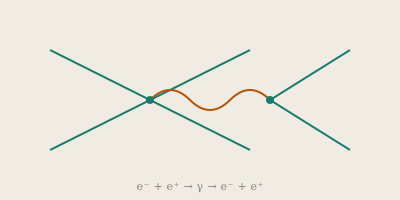
Quantum Electrodynamics
Development of the path integral formulation of quantum mechanics and its application to quantum electrodynamics (QED). This work introduced Feynman diagrams as a powerful tool for calculating particle interactions, providing an intuitive visual representation of complex quantum processes.
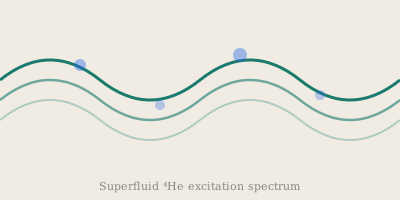
Superfluidity
Quantum mechanical explanation of the behavior of liquid helium near absolute zero. Using path integral methods, we developed a microscopic theory of the lambda transition and explained the energy spectrum of excitations in superfluid helium, including the roton minimum.
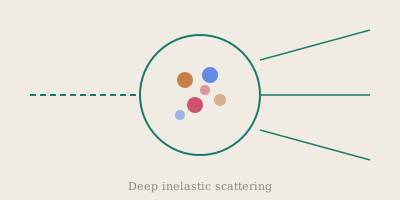
Parton Model
A model describing the internal structure of hadrons in terms of point-like constituents called partons. This framework proved essential for interpreting deep inelastic scattering experiments at SLAC and laid the groundwork for quantum chromodynamics (QCD).
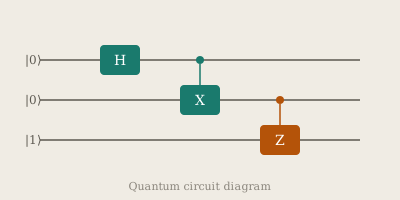
Quantum Computing
Pioneering proposals for using quantum mechanical systems to perform computation. We demonstrated that classical computers cannot efficiently simulate quantum physics, motivating the development of quantum computers that exploit superposition and entanglement.

Nanotechnology
Exploration of the physical possibilities of manipulating matter at the atomic scale. The talk “There’s Plenty of Room at the Bottom” envisioned machines that could arrange atoms one by one, anticipating modern nanotechnology and molecular manufacturing.
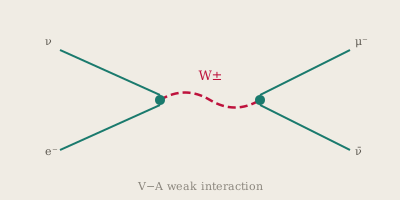
Weak Interactions
Development of the V-A theory of the weak interaction with Murray Gell-Mann. This theory correctly predicted the structure of weak decays and was later incorporated into the electroweak unification by Weinberg, Salam, and Glashow.